Total Pageviews

Thursday, July 25, 2024

AAL’S LABYRINTH HISTORY An Alternative Viewpoint…..contd. #62


c585               ANAXIMANDER (c611-c547BCE) Greek scientist and Ionian philosopher, born at Miletus and successor of Thales. He is credited as the author of the first geometric model of the universe and was possibly the first person to attempt to draw a map of the inhabited earth. Anaximander taught that there was a form of matter which had not yet taken on the properties of water, fire, earth or air. This first ‘matter’ is a single universal principle and primary source of life, which he termed ‘archae’ as the starting point and origin of the cosmic process. It was something more abstract than the ‘water’ of Thales, and had the qualities of being infinite and undifferentiated, and termed ‘Apeiron’ or boundless.  Within this ‘Apeiron’ arose two opposites or polarities of energy whose constant struggle with each other produced the phenomenal world.  Anaximander also had a theory of evolution and this was stated as being that fish were primeval and all animals issued from them, that is, life originated in the sea. (19. 114)


Anaximander with sun dial

c584               ASTYAGES (r.584-549) Iranian-Aryan and last King of Media. Astyages dreams of his daughter Mandane, as lord over the whole land. The Magi confirmed this, saying that the princess was destined to achieve some great work. In response and with the intention of preventing this event occurring, the King married his daughter to what he thought to be an inconsequential Persian by the name of Cambyses I, with the purpose of creating a union of the Medes and Persians. Whilst Mandane was pregnant, Astyages dreamt of a vine growing out of the princess and covering the whole of Asia. This child will become Cyrus the Great  [Cyrus II] who will inherit the Median Empire after defeating Astyages, and thereby establish the Achaemenid Empire. (73)


Astyages Dream
15th century French Tapestry


582                 Estimated total eclipse over Sais in ancient Egypt during the Third Intermediate Period. (240. 241)


c580              ZARATHUSTRA or Zoroaster (c628-551 BCE) possibly a second Zoroaster (see 2000 BCE) born in Medea (northern Iran/Persia). A pagan priest and prophet who reformed and gave new dimensions to the ancient polytheistic religion of Persians, a descendant branch of the Aryan Race. Known in Babylon as Zaratas, the great initiate who inaugurated the spiritual tradition of star wisdom. His new religion was based on one supreme creative principle called Ahura Mazda (wise Lord) which came out of the earlier Aryan religion of Mitra the spirit of Light. Zoroaster called Mitra the Eye of Mazda. 

                       An initiate of Zarathustra passed through 3 major grades 1. Apprenticeship. 2. Mastership. 3. Perfect Mastership. The Parsis of India are the modern descendants of Zoroastrianism. The Magi’s organisation into a graded system is reflected in the development of later occult groups (1. 102. 50a).  


Persian Magi

[photo Nickmard Khoey]


                   THE MAGI: this is a title for priests and wise men of the past. The term will become corrupted during Greco-Roman times when the magi are referred to as charlatan magicians. The original priests or magi (wise men) formulated Zarathustra’s teachings into principles of good and evil called Ohrmazd and Ahriman. Associated entities became angels or devils and eventually took on characteristics of the old gods. 

                       As a major religious authority during the Persian Empire, Zarathustra’s doctrine laid the basis for Christian and Islamic doctrines, and propagated the belief that any alternative religion was the worship of the devil. The concept of good and evil turned life after death into the familiar Hell of Christianity.


c570             JINA (599-527) Mahavira the 24th Indian teacher, who re-establishes the religion and philosophy of Jainism. This is the restoration of an ancient faith that has the severe doctrine of non-injury to all living things due to the belief that they carry soul and therefore destruction is of karmic consequence. [226. 330]


Birth of Mahavira 


Tuesday, July 16, 2024

MOON RHYTHMS

 The lunar orb is most associated with the sign of Cancer the Crab and indicates the fluctuation of moods of that sign when strong in an individual’s chart, or when indicated in a mundane or worldly situation it can be used to measure the cycles of nature. One of the most obvious and well known cycles is that of the sea tides which respond to the regular cycles of the Moon.


Egyptian Moon God Aah-Tehuti


The Moon is moving towards its greatest fullness in the cold winter nights for some and in the clear summer nights for others. As she does so the lunar orb will oppose the planets Uranus and Mars before reaching the opposition of the sun, which indicates its time of fullest glory before slowly waning once again until briefly disappearing from the night sky.


A friend asked why does the moon keep changing its shape and does its rhythmic dance affect us?


The Moon spins around our planet Earth once in 28 to 29 days and we see this happen in the sky by viewing the Moons changing light disc, which is really just the light reflected from the Sun. Each month there is a New Moon from which point the disk of light appears to grow bigger till it is a full disc in the sky. Then the disc of light starts to shrink back to nothing again. The cycle is called a Lunation and goes from one New Moon to the next. Our ‘month’ derives its name from this cycle of the Moon. Many calendars still use the Moon cycle of 13 months rather than the solar cycle of 12 months. In the dance of the Sun and Moon, is seen a cycle of basic life energy, the yin and yang of Chinese philosophy, the fire and water of Western Alchemical Tradition.


Cycle of the Sun-Moon

In viewing the sky, once a month, the moon, who travels faster than the sun, appears to catch up with the sun. The two orbs are then together in the sky from our perspective. This is called in astrology, a conjunction of the lights, and a ‘dark moon’. As the faster moving moon pulls away from the sun, and we see a thin crescent of the light of the moon appearing, it is called a New Moon. The sun represents our spiritual impulse and the moon its reflected light. The Moon is the communicator between the inner and outer life.


As the moon continues to increase its distance from the sun, following New Moon, the moon disc increases in reflected light from the sun. This is called the ‘waxing moon’. Waxing means to grow bigger or to increase.


The moon’s light continues to increase until it reaches a full disc of light as seen from Earth and it is then known as a ‘Full Moon’. In a general way the Moon collects and distributes cosmic and planetary energies to the Earth and all life on Earth. The Sun is the source of an impulse of energy; the Moon is the mother and nurturer of that impulse.


The Moon’s journey continues through a ‘waning moon’ or decreasing phase as it moves towards another conjunction with the Sun. The Moon’s refected light gradually wanes or disappears and we enter a few dark days of no moonlight. The reflecting lunar light is withdrawn.


Dance of the Sun & Moon


In the moon’s approximate 28 day journey or cycle, two points are of greater significance in the 8 phase cycle. These are the New Moon and the Full Moon phases of a Lunation, the point of meeting and the point of maximum separation; both of which indicate a time of changing currents.


A New Moon indicates a starting point, as in a new beginning.  As the moon grows in its waxing phase, there is indicated a growth phase of whatever was being considered at the starting point, it is a period of outward moving activity which reaches its peak or fruition at Full Moon. As the moon shrinks in its waning phase, there is indicated a phase of retreat, it a period of withdrawal and reflection as the process moves towards a new beginning indicated by the next New Moon. Each New Moon will occur in a successive sign of the zodiac, each sign indicating the activation of a different kind of energy to grow, reach fulfilment then fade away to an ending and new beginning.


As the Moon moves around in its monthly cycle it represents the fluctuating responses of life on Earth as seen in the sea tides or the moods and habits of people. The visible moon in its journey of changing phases indicates cycling human and cosmic energy. Dane Rudhyar in his book ‘The Lunation Cycle’ talks at length on this pulse of life. 


Sailing by moonlight on

The rhythms of the sea


Wednesday, June 26, 2024

AAL’S LABYRINTH HISTORY An Alternative Viewpoint…..contd. #61


Ezekiel’s Vision. Woodcut 1860

Julius Schnorr


c593 BCE   EZEKIEL Hebrew prophet of the ‘Old Testament’ born of priestly lineage and resident of Nippur, Sumer where the god Enlil reigns. As author of the ‘Book of Ezekiel’, he records 6 visions which he experienced during the Hebrew exile in Babylon from c593 to571 BCE, the most famous being of the Throne of God surrounded by 4 angel spirits symbolised by the 4 creatures of the fixed zodiac signs. This vision has become known as that of the ‘Divine Chariot’ or the Merkabah. It should be noted that the depiction of these winged creators has a great similarity to the winged gods of the Babylonian peoples. There may also be Hindu influence as Brahma is represented as a king with 4 heads of a similar nature. The winged heads of Ezekiel are that of a Bull, a Lion, an Eagle and a Human, conforming to the symbols of the 4 fixed signs of the zodiac, Taurus, Leo, Scorpio and Aquarius, one for each of the alchemical elements.

                       The Book of Ezekiel was probably first commenced in his 30th year in c652 BCE, its mystical and apocalyptic themes are believed to have influenced the development of the Second Temple built by the Hebrews on their return to Palestine from exile in Babylon.


                     The oft quoted Bible reference, Ezekiel:4:6 says 'I have appointed thee each day  

                   for a year'. and astrologers use this as a measurement for prediction by the stars.[59]


Greek Temple

c590               THALES (b.c. 640-546 BCE) (RC) Born at Miletus, Greece. Thales studied with the Egyptians and Babylonians and was founder of the Ionic School of philosophy in Greece. He taught that the original element or the primary source of life was water; that one divine essence is diffused throughout all being; that the universe is a living creature; that nothing is dead; even stones have souls; and that all things are full of God. He is said to have predicted the solar eclipse of 585 BCE.

                       Thales marks the transition from Homeric mythology to Classical Greek Philosophy. In the future he will be known as the first philosopher although the term philosopher will not be coined until the time of Pythagoras (525 BCE). None of Thales writings are to survive in their original form and his work will be known through the writings of the future philosopher Aristotle (354 BCE).


               THE IONIC SCHOOL: The philosophical school of Ionia is based at the city of Miletus on the coast of Asia Minor. This school brought a new way of understanding the world in its desire for system and clarity as against the vaguer concepts of mythology. This school of thought is initiated by the philosophers Thales, Anaximander and Anaximenes. Their philosophy is based on the assumption that an underlying rational unity and order exists within the flux and variety of the world, a theory that was held by the ancient Egyptians. However, in spite of this holistic view, traditional mythology now became more impersonal and based on conceptual explanations arising out of observation of natural phenomena and reasoning, rather than traditional storytelling. Through this process,  human intellectual rationalism came to dominate over the psychic life, even though maintaining some of the concepts brought over from previous ages, such as the belief that the world was one thing and had an original source which had become the manifest many. (19)


586 BCE          After standing for approximately 400 years, Solomon’s Temple of Jerusalem, housing the tablets of Moses, is destroyed and its people exiled to Babylon. Some will return to Jerusalem in 538 BCE to build a second temple which will be dedicated in 558 BCE. This temple will be embellished by the future King Herod the Great, and others ,until the time of its own destruction in 70 CE. [226] Another cycle of approximately 400 years.


Plan of Solomon’s Temple


Sunday, June 16, 2024

TALKING HERMES

 The planet Mercury is closely associated with the sign Gemini. We will meet Mercury once again in association with the sign of Virgo. When Mercury is ruling Virgo, his more practical qualities are emphasised. When Mercury is ruling Gemini, his energies work more on the plane of pure ideas and so more effort is needed to bring these thoughts and ideas down to the practical world of everyday living. Both Virgo and Gemini share in common the need to put their minds to work, to invent new ways of tackling old tasks, but in Virgo it is easier to see in what way the idea can be applied. Gemini may remain in the realm of theory, plans and discussion only, without making that little extra conscious effort to commit to paper!


Mercury is a very important planet, one whose qualities contribute to how we perceive and intellectually respond to the world around us, how we can best interrelate with people and our environment. Mercury also rules our nerve energy and so influences the way we move and speak and gesture. In Ancient Egypt the god Thoth represented these qualities. Thoth is the god of writing and recording and of spell-making. 


Thoth Ancient Egyptian god 

of writing and communication. 

By the time of the Greeks and Romans, the role of Thoth was taken over by the Greek god Hermes and the Roman god Mercury.


Hermes/Mercury [Larousse]


In Egypt, Thoth as master of writing transcribed the word of the gods so that humans could understand what was being communicated to them. The gods being represented by the other planets and acting as symbols for the different human traits such as loving [Venus] giving [Jupiter] conserving [Saturn] feeling [Moon] nobility [Sun] striving [Mars].


In Greece, as a descendent of Thoth, Hermes too communicated between the gods and humans; he wears wings on his heels for speedy transport between the two worlds, that of man and that of the gods. This hints at another Egyptian god who is called Anubis.  Anubis also commutes between the two worlds of the living and the dead and is known as a psychopomp or one who leads and guides the dead or the soul, into the world of the spirit or gods, when its physical term is completed.


Anubis leading a soul

To the other world. 

Reading mythology is a good introduction to the gods/goddesses but you have to look beyond the surface recording to see and feel what drives that myth. Try Robert Graves, ‘Greek Myths’.


Saturday, May 25, 2024

AAL’S LABYRINTH HISTORY An Alternative Viewpoint…..contd. #60


Greek Apollo Sun God 


With the 6th century BCE we enter the era of the Master Philosophers whose thoughts underpinned two thousand years of Western cultural thinking. This begins the age of the Pre-Socratic Western philosophers of Greece who sought natural rather than mythological explanations of phenomena; Thales (c590BC) Anaximander (c580BC) Anaximenes (c545BC) Heraclitus (c506BC). 

The next century will continue the trend in Parmenides (c485BC) Anaxagoras (c465BC) Empedocles (c460BC) Democritus (c430BC) (13).


This current century sees the gradual rise of naturalistic science based on sceptical rationalism and seen to develop through Eleatic rationalism, Ionian Physics and Democritus’ Atomism. (19)


A new cycle of human development is evidenced during this century, inaugurating a new set of human values and development of the mind and soul. It will be followed by five centuries of humanities attempt to adjust to this new level of being. [207]


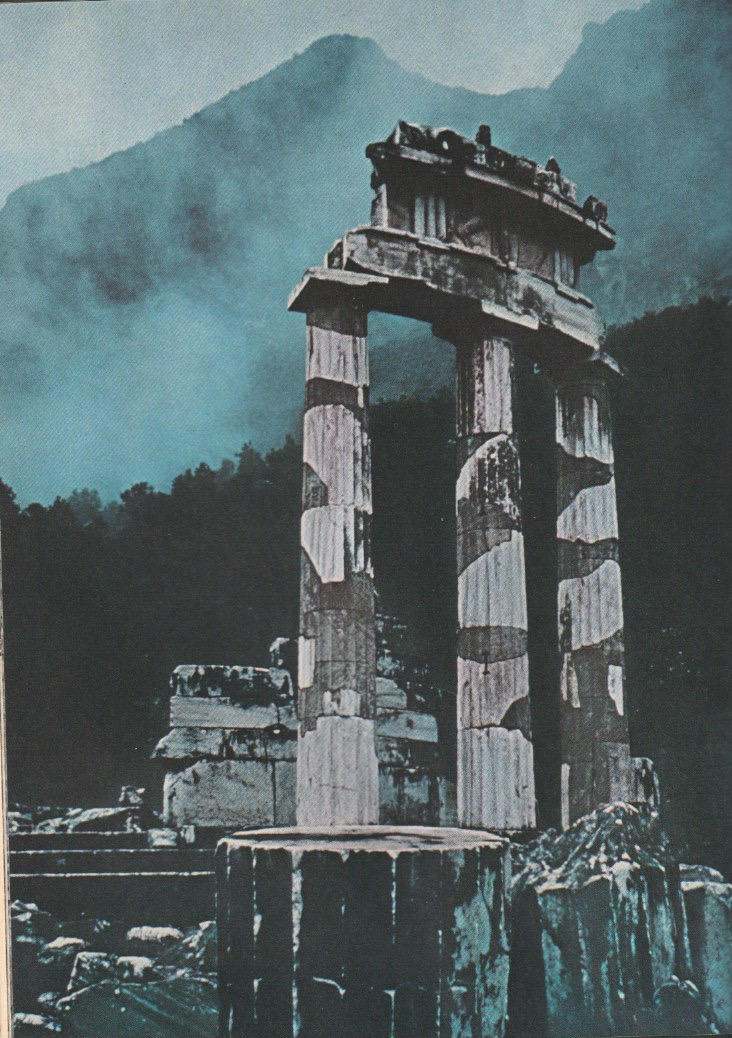
Temple of Apollo at Delphi


The great cities of Greece along the coast of Asia Minor are in touch with all the leading centres of the civilized world: Egypt, Phoenicia, Lydia, Persia and Babylon. What the Greeks borrowed they transmuted and to this added some of their own thinking. [185]

In the East is the philosophy of Lao-Tse who was born at the end of the previous century but there is indication of his philosophy filtering into the west, probably along the ‘Silk Road’ of trading and even perhaps in the explorers from the west travelling east and then returning with new ways of thinking. Other influences come from India and Asia to meld with those of the west.


598 BCE     SOLON (c638-558) Greek Athenian Law maker who is instructed on the mysteries by the priests of Sais in Egypt during a visit there in the time of Pharaoh Amasis I. The priests also told Solon of the story of Atlantis, which he will in turn transmit to Plato (c560 BCE). [72.103] According to Plutarch, Solon received his instructions from the priest Sonchis of Sais. (250)


Egyptian Priest

paying Homage to the gods


c597 BCE     NEBUCHADNEZZAR II leads the Babylonians to conquer Jerusalem around this time. With the Assyrian defeat of Egypt, the final fall of the Israelite monarchy is achieved by c586 BCE. Jerusalem and its Temple are destroyed and the Hebrews are exiled to Babylon for 70 years where they are to become scholars of the Babylonian star religion. The Hebrew people are now dispersed as exiles and refugees, going between their homeland, Egypt and Babylon. (102. 9)

            The Semitic Chaldeans of Babylon are attributed with the introduction and development of astrology. It is thought that writing and magic were a Turanian or Sumerian (Akkadian) contribution to Babylonian civilization but that astronomy and astrology were Semitic innovations. (1)


                The Prophet Ezekiel said ‘I have appointed thee each day for a year’ and astrologers use this as a measurement for prediction by the stars.


591                 The capital of Kush [Nubia/Northern Sudan] is moved from Napata to Meroe, by the kings of the 25th Dynasty of Egypt. The Meroe civilization blended Egyptian, Hellenistic and Indian influences into a unique culture, which included their own form of writing, a cursive script that remained undeciphered until the end of the 20th century CE.


Sunday, May 12, 2024

EARTHLY QUEEN


Sigil of the Bull

The Taurean Bull of course can be tracked back to the ancient Egyptian Apis Bull and his partner. The Apis Bull was the sacred symbol of Osiris and through him of his partner Isis/Hathor who sometimes sports the cow head. It is quite debatable which had the most authority, but it is highly suspicious that it was Isis who was the goddess to give birth to the child Horos or Hour.  Horos or Hour, a segment of time-space and symbol of the creative qualities as the Great Mother Goddess. However, make no mistake that Isis would remain barren without the stimulation, seeding and support of Osiris. It does and always will take two to tango or in other words a polarity to create a third condition generated out of that polarity. Think carefully upon these words, said the master.


Isis and Osiris are the cosmic polarities of the ‘All’; the male and female principles of life, and their story is retold by Plutarch. Plutarch had learnt a lot from the High Priestess Clea.


Hathor 

An aspect of the 

Great Mother Goddess.


Venus is the planet most associated with the Earth sign Taurus. Venus is symbolised in the ancient Goddess Hathor. Hathor wears the cow head symbolised in the horns of potency and the disk of creation.


The other image of Venus is the classical Greek goddess Aphrodite, an image that over emphasises the feminine. And yet one can still sense some yang energies to be present and to keep the balance going.  Aphrodite has absolute ‘feminine’ appeal, yet with a hidden stress of being her own person. 


Aphrodite of Greece


In fact, Aphrodite can be quite harsh in her search for equality, balance, harmony, and justice. When these desires are harnessed to the Bullish qualities of Taurus, there is not likely to be a middle path towards achieving that peace according to the Taurean will; a will-power that is strong and determined yet ready to play ball with the opponent if good practical reason is given and the production of harmony is sensed as the end product. Image assaulting the earth in order to planet a rose tree. The rose tree blooms and reminds us of the beauty of life well lived in balance.


Equally, we will see this drive in the Libran Venus. If Venus cannot be bothered with all the inconvenience of war then she is likely to sit down and refuse to move or to be concerned about the state of things. We will come to this in the October sign of Libra who also is strongly associated with the planet Venus.


The month of May is the time of year to pay homage to the Queen of Mother Earth, the goddess Flora or her associate Persephone the daughter of Demeter. Flowers are one of the attributes of the planet Venus symbolising the love of nature in its beautiful and harmonious aspect.


Persephone or goddess Flora


Tuesday, April 16, 2024

AAL’S LABYRINTH HISTORY An Alternative Viewpoint…..contd. #59


Wise men of Chaldea


625BCE           NABOPOLASSAR (r. 625-604 BCE) sheikh of a Semitic Chaldean tribe (76) and first king of the New Babylonian Empire, he takes over the Assyrian capital Nineveh, with the help of the Medes and Persians. Thus, independence from the Assyrians is gained for Babylon. This is known as the state of the New Babylon or Chaldea. The latter title probably comes from the naming of the intellectuals as Chaldeans or wise men and referring to  both Babylonians and captured Hebrews Nabopolassar’s son NEBUCHADREZZAR (76) is the second king of the New Babylonian Empire. He continues the rebuilding of Babylon after its destruction by the Assyrians in 689 BCE. New buildings included the ‘Hanging Gardens’, nominated as one of the ‘Seven Wonders of the World’. Possibly these gardens were built on a stepped pyramid called a ziggurat.


‘ Hanging Gardens ‘of Babylon

[An imaginary 19th century depiction]


609                 JEHOIAKIM king of Judah, the southern kingdom of ancient Israel, from 609 to 598 BCE. When King Josiah died at Megiddo in 609, he was succeeded by his son Jehoahaz.  The Egyptian pharaoh Necho, however, deposed Jehoahaz and placed Jehoiakim, also a son of Josiah, on the throne (II Kings 23). Judah will subsequently come under Babylonian domination, but Jehoiakim will rebel about 601 and then die shortly before Nebuchadnezzar II takes Jerusalem in 597.  The prophet Jeremiah speaks of the reign of Jehoiakim (Jeremiah 36).


Josiah of Juda

[An imaginary 16th century portrait]


606                 CYAXARES descendant of Median Deioces (708 BCE). He makes an alliance with the Babylonians against the Assyrians. Later, Cyaxares will destroy Nineveh, capital of Assyria, when he annexes Assyria in 612. By this action he extends the Median Empire. (40)


c604 BCE        LAO-TSE ancient Chinese sage whose name means ‘old boy’ or ‘venerable philosopher’. He is the founder of the philosophy of Taoism, which is recorded in the T’ao-Teh King’.  Lao-Tse is a contemporary of Confucius upon whom he had some influence.  As librarian and archivist of the royal house of the Chou dynasty, Lao-Tse resided in the capitol of Chow.  Retiring from the world at the distress of its evils, he took up the command of the ‘warden of the outer gate’.

He then put into book form the essence of his teachings, known as the doctrine of ‘The Way’ or ‘Tao’. During his life Lao-Tse attempted to make no converts to the Tao, possibly because he realized that his philosophies were far ahead of his age and that people were not ready to receive such teachings.  Lao-Tse professes to be the transmitter of an earlier knowledge of Hwang-Ti rather than the originator of ‘The Way’ and the ‘I Ching’ or ‘Book of Changes’. Hwang-Ti is the legendary civilizer of China c2704 BCE. (6)


                   Lao-Tse


c600         From the Egyptian cursive writing known as Hieratic, develops an even more cursive from of script known as demotic (of the people). (144). Demotic looks very similar to Hebrew and indeed later research shows that Hebrew ideograms are derived from Egypt.


                     The end of the 7th Century BCE brings the official founding of Dionysiac feasts at Corinth, Sicyon, Athens, (33) whilst in Europe, the ‘Hallstatt’ Culture of the Celtic people is giving way to the ‘La Tene’ culture which is to develop into a highly refined living, as reflected in their art works. The original ‘La Tene’ settlement is by the lake of Neuchâtel, Switzerland and marks a second and more sophisticated period of Celtic culture that is to develop. By 100 BCE this culture will succumb to the growing Roman Empire. [371]


5th century Celtic ornament